FIFA Presidency: UEFA Picks Philippe Diallo To Challenge Infantino
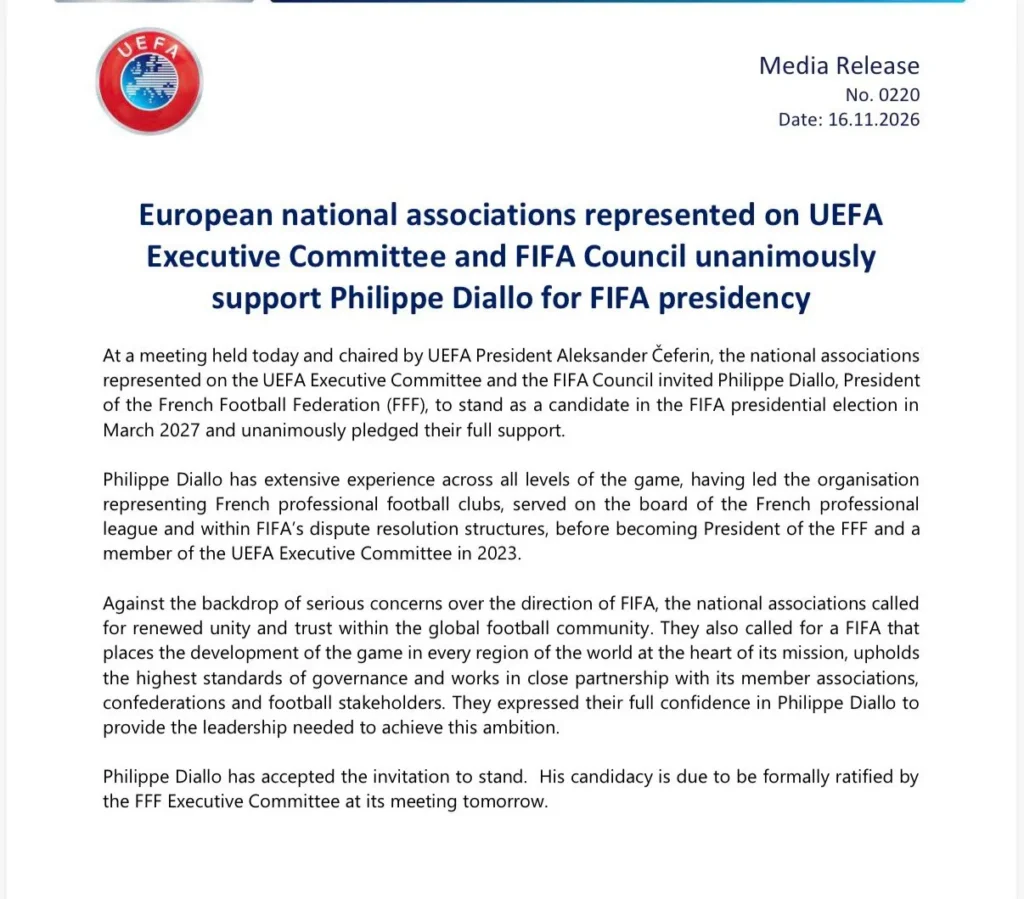
French Football Federation (FFF) president Philippe Diallo has emerged as the preferred challenger to Gianni Infantino in the race for the FIFA presidency after receiving unanimous backing from senior European football associations represented on UEFA’s executive committee and the FIFA Council. Mr Diallo has accepted the invitation, although the FFF Executive Committee is expected to ratify his candidacy at its meeting o.
The development gives UEFA a candidate to challenge Mr Infantino, who is seeking another term as FIFA president despite growing criticism of his leadership following a failed proposal to open part of the organisation’s commercial business to private investors.
UEFA said the decision followed serious concerns about FIFA’s direction. It called for renewed unity and trust in world football, stronger governance and greater attention to developing the game across all regions.
UEFA statement
The election is scheduled for 18 March 2027 in Rabat, Morocco. Candidates have until Wednesday, 18 November, to secure the required nominations from at least five of FIFA’s 211 member associations.
Who is Philippe Diallo?
Mr Diallo, 63, has been president of the French Football Federation since 2023. He was initially appointed interim president after Noël Le Graët resigned, then elected in June that year.
He was re-elected in December 2024 for a four-year term running until 2028 and has served on the UEFA Executive Committee since 2023.
Before taking charge of French football, Mr Diallo spent nearly three decades in football administration. He led the organisation representing professional football clubs in France from 1992 to 2021, served on the board of the French Professional Football League and worked within FIFA’s dispute resolution structures.
His experience in football administration and governance appears central to UEFA’s decision to back him.
The French federation had earlier withdrawn its support for Mr Infantino’s re-election. On 10 September, its executive committee unanimously reversed its initial endorsement, citing concerns about FIFA’s governance and how it handled major decisions.
Mr Diallo said at the time that the trust placed in the FIFA president had been broken.
The crisis behind the challenge
The disagreement centres largely on FIFA Forward Enterprise (FFE), a proposed commercial company that would have brought together FIFA’s commercial rights and the operational delivery of its competitions, including the World Cup.
The proposal included selling up to 20 per cent of the company to private investors in a deal that was expected to raise billions of dollars.
However, the plan faced strong opposition from football administrators, who questioned the lack of consultation and transparency around an initiative with significant implications for the sport’s future.
FIFA abandoned the proposal on 1 August following the backlash. The decision did not end the dispute, as critics continued to demand an independent review of the process and changes to the organisation’s governance.
The controversy also led to the departure of senior FIFA officials, including chief operating officer Kevin Lamour and senior adviser Carlos Cordeiro, further deepening questions about the organisation’s internal management.
Several national associations subsequently withdrew or questioned their earlier support for Mr Infantino’s re-election.
The six Nordic football associations – Denmark, Iceland, the Faroe Islands, Finland, Norway and Sweden – jointly declared in August that they had lost confidence in his leadership, citing concerns about FIFA’s governance and high-level decision-making.