
2027: Young Voters, Old Politicians
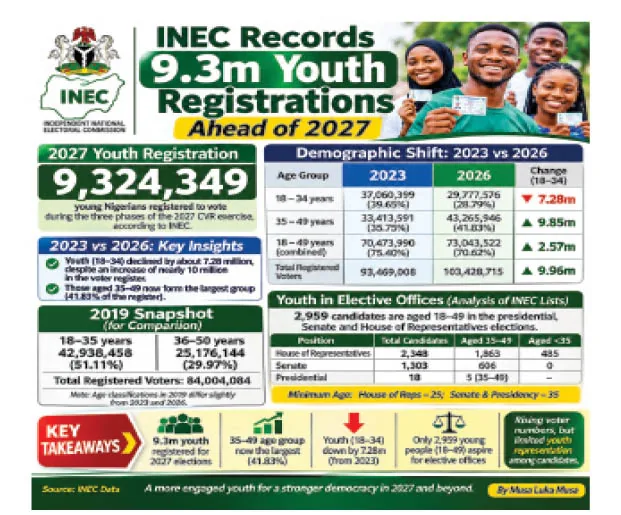
Amidst debates on the level of youth participation in Nigeria’s political process, the Independent National Electoral Commission (INEC) says only 9,324,349 young Nigerians registered to vote during the three phases of the Continuous Voter Registration (CVR) exercise recently conducted ahead of the 2027 general elections.
The demographic composition of the entire voters’ register analysed by Niawaves indicates that much has changed ahead of the 2027 elections as figures presented by INEC in October showed that voters aged between 18 and 34 number 29,777,576, representing 28.79 per cent of the 103,428,715 registered voters.
In contrast, those aged 35 to 49 now constitute the largest category, with 43,265,946 voters, representing 41.83 per cent of the register.
The INEC chairman, Prof Joash Amupitan, who disclosed the figure at an investiture of the commission’s Youth Ambassadors in Abuja, said the number underscored the importance of young Nigerians in the country’s democratic process.
The figure comes against the backdrop of the 2023 general elections when young people aged 18 to 34 constituted the largest demographic group on the voter register, with 37,060,399, representing 39.65 per cent of the 93,469,008 registered voters, according to INEC’s 2023 General Election Report.
The figures raise questions about the changing age composition of Nigeria’s electorate and the extent to which newly eligible young Nigerians are participating in voter registration and other aspects of the political process.
For the 2019 general elections, INEC recorded 42,938,458 voters aged 18 to 35, representing 51.11 per cent of the 84,004,084 registered voters, while another 25,176,144, representing 29.97 per cent, were aged 36 to 50.
However, the age classifications used in the 2019 report differ slightly from those of 2023 and 2026, making a direct comparison of the same age groups across the three registration periods difficult.
The figures highlight a changing demographic composition of the electorate, although the movement of voters from one age category to another as they grow older must also be considered when interpreting the trend.